Do you think the way your parents shared housework is different from how you share it now?
Match the word to its definition.
<aside>
convergence
disparity
breadwinner
</aside>
<aside>
the person who earns the most money in a family
the process of things coming closer together or becoming more similar.
a big difference between two or more things.
</aside>
Read the following text.
<aside> 🧹
Since the 1980s, the way men and women share housework has slowly changed across the Western world. While a gap still exists, we are seeing a clear convergence, meaning men are doing more unpaid work at home and women are doing less.
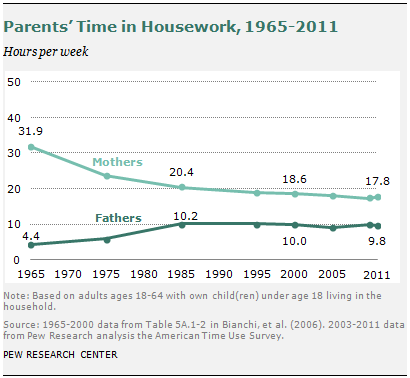
Let’s look at the United States. In 1965, mothers spent about 35 hours a week on housework, while fathers spent only five. The disparity was huge. By 2011, the numbers showed a big shift. Women’s housework time nearly halved to 15 hours per week, while men’s time doubled to around nine hours.
The Scandinavian countries, like Sweden and Norway, show the most equality. In Norway, fathers spent 55 minutes more per day on family work in 2010 than they did in 1980. The main reason for this slow revolution is that more women have entered the paid workforce. This has challenged traditional gender roles. However, the journey to true equality is not finished. Women, even those who are the main breadwinners, still do the majority of the chores.
Source: Pew Research
</aside>
Choose the correct preposition.